
Sorry, but your login has failed. Please recheck your login information and resubmit. If your subscription has expired, renew here.
Procurement excellence has long meant concentrating effort where the returns are highest. Strategic suppliers and high-spend categories earn attention because complex negotiations reward depth, and they tend to deliver repeatable savings and tighter risk control across cycles.
The long tail has been different. Tail suppliers often make up 60% to 80% of the supplier base but only 10% to 20% of spend, so the economics rarely worked. Advanced sourcing, supplier management, and compliance efforts were hard to justify when each incremental interaction cost more than it returned.
That constraint is weakening. AI is lowering the effort required per supplier touch, which changes unit economics and makes scaled engagement practical. As a result, procurement can extend control and capture value in the tail without adding disproportionate capacity.
SC
MR
Sorry, but your login has failed. Please recheck your login information and resubmit. If your subscription has expired, renew here.
Procurement excellence has long meant concentrating effort where the returns are highest. Strategic suppliers and high-spend categories earn attention because complex negotiations reward depth, and they tend to deliver repeatable savings and tighter risk control across cycles.
The long tail has been different. Tail suppliers often make up 60% to 80% of the supplier base but only 10% to 20% of spend, so the economics rarely worked. Advanced sourcing, supplier management, and compliance efforts were hard to justify when each incremental interaction cost more than it returned.
That constraint is weakening. AI is lowering the effort required per supplier touch, which changes unit economics and makes scaled engagement practical. As a result, procurement can extend control and capture value in the tail without adding disproportionate capacity.
Where procurement AI still breaks down
AI is already part of the mainstream procurement toolkit. Advanced analytics sharpen category strategy, algorithms pressure test tender scenarios, and data-driven insights improve negotiation preparation. Teams move faster and make better decisions, but most operating models still look
the same.
What has not changed is the structural cost of managing thousands of low-spend suppliers through human-led workflows. That is why tail spend remains procurement’s blind spot: not because it lacks value, but because traditional models were never designed to manage the long tail at scale.
From spend intelligence to autonomous procurement execution
Tomorrow’s procurement AI expands what procurement can execute. Instead of using AI only to inform human decisions, leading organizations are beginning to use it to carry out commercial actions that often never happened at all. What if procurement could reach every supplier, not just the strategic few?
AI-enabled negotiation makes this possible by autonomously engaging tail suppliers, the ones conventional models rarely touch. When outreach, interaction, and follow-up are automated, procurement can engage suppliers that were previously too costly to address.
The real change is capacity to act, supported by a fundamentally different execution model. That model combines human commercial judgment—setting intent, validating assumptions, defining boundaries—with AI that applies that intent consistently across large supplier populations using internal and external data.
It’s execution that multiplies reach without watering down rigor.
Scalable execution layer 1: Scalable definition of supplier asks
This layer defines what to negotiate and how. AI generates supplier-specific negotiation asks by combining spend analysis with enriched internal and external data. From there, teams validate the assumptions, confirming that proposed levers are economically meaningful and commercially relevant. Execution begins only when those levers meet quality standards and align with business priorities. In practice, this gate keeps negotiations defensible and consistent across supplier segments.
Scalable execution layer 2: Automated negotiation at scale
The second layer is where AI shifts to execution. Suppliers are engaged through automated channels, then guided by an AI-powered chatbot with predefined arguments, boundaries, and escalation rules. No human intermediary is required, and as a result, thousands of negotiations launch simultaneously with full traceability.
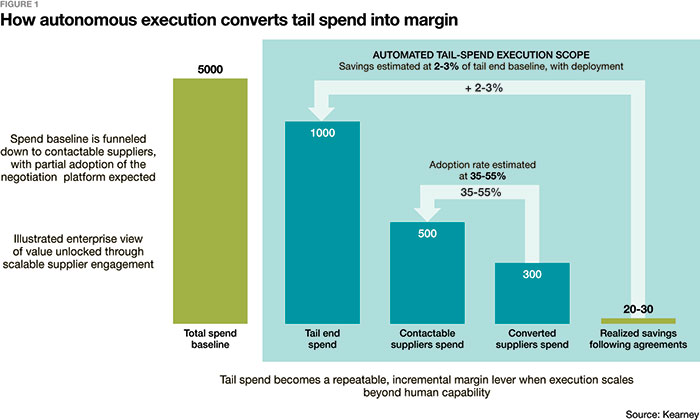
Tail supplier engagement, once ignored for lack of capacity, becomes operationally and economically feasible at scale with AI—without adding headcount (see Figure 1).
Autonomous negotiation arrives
Autonomous negotiation platforms are emerging to address procurement’s capacity constraint, embedding AI directly into supplier communication workflows. Providers differ in maturity but share a common goal of operational deployment at scale. As adoption grows, the differentiator will be deployment effectiveness, specifically, how well organizations govern AI and integrate it into their broader procurement strategy.
Two conditions that shape value realization
Evidence from initial deployments highlights two conditions that reliably shape value realization, the first being human oversight with business grounding. AI effectiveness scales with the quality of the business intent and contextual guidance that shape it. Mapping enterprise objectives into defensible negotiation parameters links negotiation outcomes to margin improvement and productivity gains while supporting resilience.
The second condition is systematic integration. AI tail spend intervention works best when it is designed and governed as part of the broader procurement operating model. Value is maximized when it operates within an end-to-end procurement execution program that intentionally covers the entire supplier panel: high-touch engagement for strategic suppliers, structured sourcing for mid-tier suppliers, and automated AI execution for tail suppliers, with effort matched to return.
From neglected spend to managed value
AI-enabled tail spend engagement warrants a realistic assessment of its practical limits. The economic benefit from any single supplier engagement will be limited, and outcomes across the population will show variable success rates. When aggregated across hundreds or thousands of suppliers, however, the cumulative impact becomes substantial, and critically, this value is additive to the results procurement teams are already generating through conventional approaches.
By making previously infeasible negotiations operationally viable, AI extends procurement’s effective coverage across the supplier base without requiring teams to dilute their attention on strategic supplier relationships. It allows organizations to apply commercial discipline across the entire supplier landscape, allocating attention and resources proportionally to the value potential present at each tier.
High-touch engagement will remain essential for top spend suppliers, with AI extending procurement’s reach across the rest.
The authors would like to thank Selma Souissi, Anshuman Sharma, Anshuman Jayakrishnan Jayaram, and Anagha Tupe for their contributions to this article.
About the authors
Vijay Kasi is a Kearney partner who specializes in consumer and retail operational transformation and can be reached at [email protected].
Alexander Wirtz is a Kearney partner who focuses on digital procurement and advanced analytics and can be reached at [email protected].
Remco Kroes is a Kearney partner with a focus on large-scale operations transformations and can be reached at [email protected].
Sandra Pierrard is a Kearney principal driving M&A strategy, merger integrations, and private equity value creation and can be reached at [email protected].
SC
MR


More Procurement Strategy
- AI and the new economics of tail spend
- The $4 million procurement gap
- From cost control to value realization: Rewiring the airline source-to-pay value chain
- Automation is the easy part: The real AI shift in procurement starts now
- Three ways AI can help CSCOs navigate emerging supply chain cost pressures
- More Procurement Strategy
What's Related in Procurement Strategy

 Explore
Topics
Procurement & Sourcing News
- Why companies blame the wrong supplier … and miss the real failure
- NextGen Supply Chain Conference unveils agenda focused on AI, execution and the future of leadership
- From fragmented negotiations to coordinated negotiation performance: an AI-enabled approach
- Supply chain resilience isn’t a data problem; it’s a judgment problem
- Why your supply chain risk management plan will fail
- When component verification becomes operational
- More Procurement & Sourcing
Latest Procurement & Sourcing Resources
Subscribe

Supply Chain Management Review delivers the best industry content.

Editors’ Picks



